Now Accepting Pre-Orders - Save $50
Industry Reality
A single parted line itself may cost almost nothing. A drifting barge hitting critical infrastructure can become one of the most expensive casualty types in inland or coastal marine operations because:
- kinetic energy is enormous,
- waterways are interconnected,
- and liability expands rapidly once navigation, environment, or public safety are affected.
A New Solution for Breakaway Response Plans
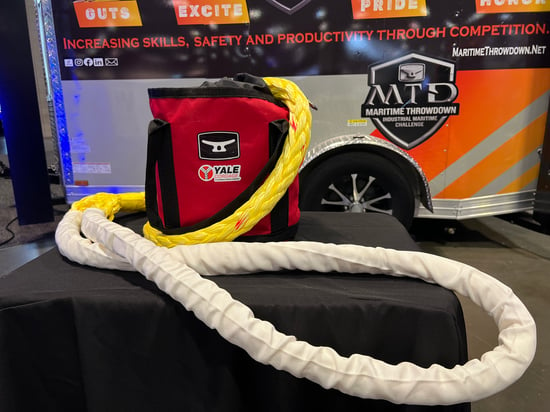
Maritime Throwdown and Yale Cordage (a Slingmax Group Company) offer a low-cost, high-impact solution for your barge breakaways plan. Designed by Captain Kenny Brown, founder and president of The Maritime Throwdown, the MTD™–Yale Ultrex® Line Stow-n-Throw™ bag is a turnkey option. Priced at $849.99 each, the Stow-n-Go™ helps crews respond to incidents ranging from minor operational disruptions to catastrophic, multi-million-dollar casualty events.
In a breakaway, seconds count as your crew assesses:
- Severity of the breakaway
- Waterway/environment involved
- Cargo type
- Damage to people, property, and infrastructure
- Regulatory and legal consequences
- Business interruption and reputational harm
Drawing on 20 years as a captain on the inland waterways, Captain Kenny has witnessed too many breakaway incidents. He grouped them into three scenario types and outlined their typical causes, potential costs, risks, and operational impacts. The sections below summarize this framework.
Biggest Risk Drivers
The true exposure depends heavily on these factors:
|
Risk Driver |
Lower Risk |
Higher Risk |
|
Cargo |
Empty/dry cargo |
Fuel, chemicals, hazmat |
|
Location |
Fleeting area |
Bridge/lock/urban waterway |
|
Weather |
Calm conditions |
Flood/storm/ice |
|
Number of barges |
Single |
Multiple barges |
|
Population density |
Remote river |
Urban waterfront |
|
Response time |
Immediate |
Delayed recovery |
|
Mooring quality |
Engineered system |
Improvised setup |
Scenarios
BEST CASE (Low Severity / Controlled Event) Scenario - A light or empty barge parts a line at a fleeting area or dock during weather or shifting current, but remains within the facility or is quickly recovered.
BETTER / MODERATE CASE (Serious but Contained) Scenario - A loaded barge breaks free and drifts into:
GOOD / WORST-CASE CATASTROPHIC EVENT – Scenario A barge (i.e. petroleum barges, chemical barges, or multiple barges breaking loose in a fleet) breakaway during high water, storm surge, or ice/current event results in:
Potential Costs Tug assistance / recovery: $5,000–$50,000 Dock crew overtime Minor line replacement Small repair costs Short operational delay
Potential Costs Salvage/towing operations: $50,000–$500,000+ Structural repairs: $100,000–$2M+ Pollution cleanup: $25,000–$500,000+ Cargo loss or contamination Insurance deductibles Legal defense costs USCG investigations Waterway closure losses
Potential Direct Costs Major salvage: $1M–$50M+ Bridge or lock damage: $10M–$100M+ Environmental cleanup: $1M–$500M+ Vessel replacement Cargo claims Wreck removal
Potential Costs Tug assistance / recovery: $5,000–$50,000 Dock crew overtime Minor line replacement Small repair costs Short operational delay
Potential Costs Salvage/towing operations: $50,000–$500,000+ Structural repairs: $100,000–$2M+ Pollution cleanup: $25,000–$500,000+ Cargo loss or contamination Insurance deductibles Legal defense costs USCG investigations Waterway closure losses
Potential Direct Costs Major salvage: $1M–$50M+ Bridge or lock damage: $10M–$100M+ Environmental cleanup: $1M–$500M+ Vessel replacement Cargo claims Wreck removal